





.webp)
Introduction
WhatsApp Business API, now part of the WhatsApp Business Platform, helps businesses to connect WhatsApp with their CRM, website, payment systems, helpdesk, ERP, and other business applications. But from a business perspective, its real value is much simpler: it helps teams spend less time on repetitive messages and more time on conversations that actually need a human touch. Instead of having employees manually send every update, reminder, follow-up, or response, businesses can automate these interactions while still keeping communication personal and timely. At Bitsware, we help businesses implement WhatsApp Business API solutions to streamline customer communication, automate repetitive workflows, and connect WhatsApp with their existing business systems.
For Indian businesses, this makes WhatsApp particularly useful across sales, customer support, ecommerce, payments, logistics, appointments, and customer retention. More than 200 million businesses use Meta’s business tools each month, while more than 175 million people message a WhatsApp Business account every day. Third-party industry estimates suggest that around 1.9- 2.2 billion business messages are exchanged through WhatsApp daily, further highlighting the scale of business communication taking place on the platform. In India, the opportunity is particularly significant: 91% of online adults chat with a business every week, according to a Kantar 2025 study cited by Meta.
One thing is becoming clear: customers increasingly expect businesses to be quick, accessible, and easy to communicate with. WhatsApp fits naturally into that expectation. So, rather than looking at the WhatsApp Business API as just another messaging tool, it is worth looking at where it can actually make a difference to day-to-day business operations.
In this blog, we will explore 5 practical WhatsApp Business API use cases for Indian businesses in 2026, along with how each use case works, where it creates business value, and what businesses should consider before implementing WhatsApp automation.
WhatsApp Business API Use Cases at a Glance
.webp)
What Is WhatsApp Business API?
WhatsApp Business API, officially provided through the WhatsApp Business Platform, is a business messaging solution that allows companies to automate customer communication, integrate WhatsApp with CRM and ERP systems, send notifications, manage customer support, and scale conversations across multiple employees and business workflows.
The WhatsApp Business API is designed for medium and large businesses that need programmatic access to WhatsApp messaging.
Unlike the regular WhatsApp Business App, the API can be connected to business systems such as:
* CRM platforms
* ERP and accounting software
* Ecommerce websites
* Payment gateways
* Helpdesk systems
* Logistics platforms
* Appointment systems
* Marketing automation tools
This allows businesses to create automated workflows while still giving customers the option to interact with human support teams when necessary.
WhatsApp Business App vs WhatsApp Business API
.webp)
The key difference is simple: the WhatsApp Business App helps a business manage conversations, while the WhatsApp Business Platform allows WhatsApp conversations to become part of larger business workflows.
Why Should Indian Businesses Use WhatsApp Business API?
Indian businesses use WhatsApp Business API to automate lead management, customer support, payment reminders, order updates, appointment scheduling, document sharing, and customer engagement through a communication channel that customers already use regularly.
For many businesses, the challenge is not communicating with customers but managing communication efficiently as customer volume grows.
Manual WhatsApp communication can lead to:
* Slow lead responses
* Missed follow-ups
* Repetitive support work
* Untracked customer conversations
* Delayed payment reminders
* Manual order-status updates
* Inconsistent customer experiences
WhatsApp Business API addresses these challenges by connecting customer conversations with the systems already used to operate the business.
Instead of treating WhatsApp as another standalone communication channel, businesses can make it part of their sales, support, payment, ecommerce, and customer-retention workflows.
What Are the Most Common WhatsApp Business API Use Cases?
The most common WhatsApp Business API use cases include lead qualification, CRM integration, payment collection, customer support automation, order tracking, appointment reminders, abandoned cart recovery, customer feedback, subscription renewals, advertising, and document sharing.
The following 10 use cases show how Indian businesses can apply WhatsApp Business API to practical business processes.
5 WhatsApp Business API Use Cases for Indian Businesses
1. Lead Generation and Instant Lead Qualification
How does WhatsApp Business API help with lead generation?
WhatsApp Business API helps businesses qualify leads automatically by collecting customer information, asking predefined questions, routing enquiries to sales teams, and integrating conversations with CRM platforms such as Zoho CRM, Salesforce, and LeadSquared.
One of the most valuable WhatsApp API use cases is automating the first stage of the sales process.
A potential customer may arrive through:
* A website enquiry form
* Click-to-WhatsApp advertising
* A product page
* A social media campaign
* A QR code
* An online marketplace
Instead of waiting for a salesperson to manually respond, a connected WhatsApp workflow can immediately start the conversation.
For example:
Customer: I want to know the price of your ERP software.
Automated WhatsApp: Sure. Which type of business do you operate?
Customer: Manufacturing.
Automated WhatsApp: How many users will need access?
The collected information can then be sent to a CRM and assigned to the appropriate salesperson.
Why it matters
This helps businesses:
Respond to enquiries faster
Collect basic lead information automatically
Reduce repetitive sales work
Route leads to the right salesperson
Maintain a central record of conversations
For Indian businesses running digital advertising campaigns, connecting Click-to-WhatsApp ads with CRM and sales automation can create a more connected lead-management process.
2. Payment Reminders and Invoice Collection
Can WhatsApp Business API send payment reminders?
Yes. Businesses can use WhatsApp Business API to send automated payment reminders, invoice notifications, payment confirmations, receipt notifications, and relevant UPI or payment links directly to customers, depending on the payment integration.
WhatsApp can become part of the accounts-receivable process.
Businesses can connect their accounting or billing system with WhatsApp to send customers reminders such as:
Your invoice is due on 25 August.
Amount payable: ₹18,500.
Pay securely using the link below.
Depending on the payment setup, the message can direct customers to a UPI payment link, payment gateway, or online payment page.
Common applications
Invoice reminders
Payment due alerts
Outstanding payment follow-ups
Subscription renewal reminders
Payment confirmations
Receipt notifications
This can be especially useful for B2B companies, distributors, educational businesses, service providers, and subscription-based businesses.
The advantage is not simply sending another reminder. The real benefit is connecting the reminder to the company's existing financial workflow.
3. 24/7 Customer Support and FAQs
Can WhatsApp Business API be used for customer support?
Yes. Businesses can automate common customer queries, provide instant responses, collect customer information, and transfer complex issues to human support agents through integrated helpdesk or CRM systems.
Customer support teams often spend significant time answering repetitive questions.
Examples include:
* What are your business hours?
* Where is my order?
* What is your return policy?
* What documents are required?
* How can I book a service?
* What is the status of my request?
How can I make a payment?
A WhatsApp chatbot or AI-powered support system can handle common questions and collect information before transferring complex cases to a human agent.
Example workflow
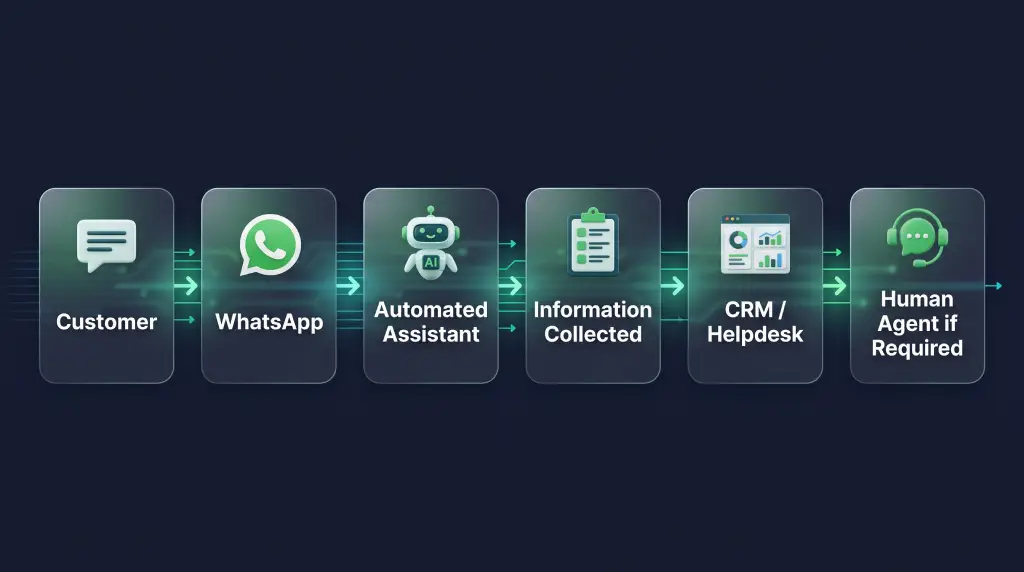
This creates a hybrid support model where automation handles routine conversations while employees focus on issues that require human judgement.
For Indian businesses, multilingual support can also be valuable when customer conversations need to be handled in English, Hindi, Gujarati, Marathi, Tamil, Telugu, Bengali, or other regional languages, depending on the capabilities of the connected solution.
4. Sending Quotations, Catalogues and Business Documents
Can businesses send quotations and proposals through WhatsApp Business API?
Yes. Businesses can share quotations, product catalogues, proposals, invoices, brochures, product specifications, and other relevant business documents within WhatsApp conversations, depending on the supported messaging and integration setup.
WhatsApp is useful not only for text conversations but also for sharing business information and documents.
Sales teams can use automated workflows to send:
Product catalogues
Price lists
Quotations
Brochures
Product specifications
Service details
Proposals
Order information
Other relevant documents
For example, a customer enquiring about industrial products could receive a catalogue first, followed by a quotation after providing the required specifications.
Why businesses use this workflow
It can reduce unnecessary back-and-forth between sales teams and customers while keeping the conversation in a familiar communication channel.
For B2B businesses, WhatsApp can therefore complement,not necessarily replace, email and other formal communication channels.
5. Order Confirmation and Delivery Updates
Can WhatsApp Business API send delivery updates?
Yes. Businesses can automatically notify customers about order confirmation, packing, shipping status, delivery schedules, tracking information, and order completion through WhatsApp when connected to their order-management or logistics systems.
Ecommerce and retail businesses can connect WhatsApp with their order-management or logistics systems to automatically notify customers about order progress.
Typical notifications include:
.webp)
Businesses can also provide customers with tracking information when available.
This can help reduce repetitive support questions
Instead of customers repeatedly asking:
Where is my order?
They can receive proactive updates throughout the delivery journey.
This use case is particularly relevant for:
Ecommerce businesses
D2C brands
Retailers
Distributors
Food businesses
Consumer electronics companies
Logistics-dependent businesses
The result is a more transparent post-purchase experience and fewer manual status-update conversations.
Conclusion
The WhatsApp Business API is more than a way to keep up with changing customer habits in India, it is a practical way to make business communication faster, smarter, and more scalable. By replacing fragmented manual chats with automated workflows, CRM integrations, instant payment links, and 24/7 customer support, businesses can improve response times, accelerate sales, reduce operational effort, and create more consistent customer experiences.
Choosing an official Business Solution Provider such as Bitsware can further simplify implementation while helping businesses build a secure, compliant, and scalable messaging infrastructure. When every conversation is connected to the right workflow, WhatsApp becomes more than a communication channel, it becomes a measurable driver of customer engagement, sales, and business growth.
.png)