




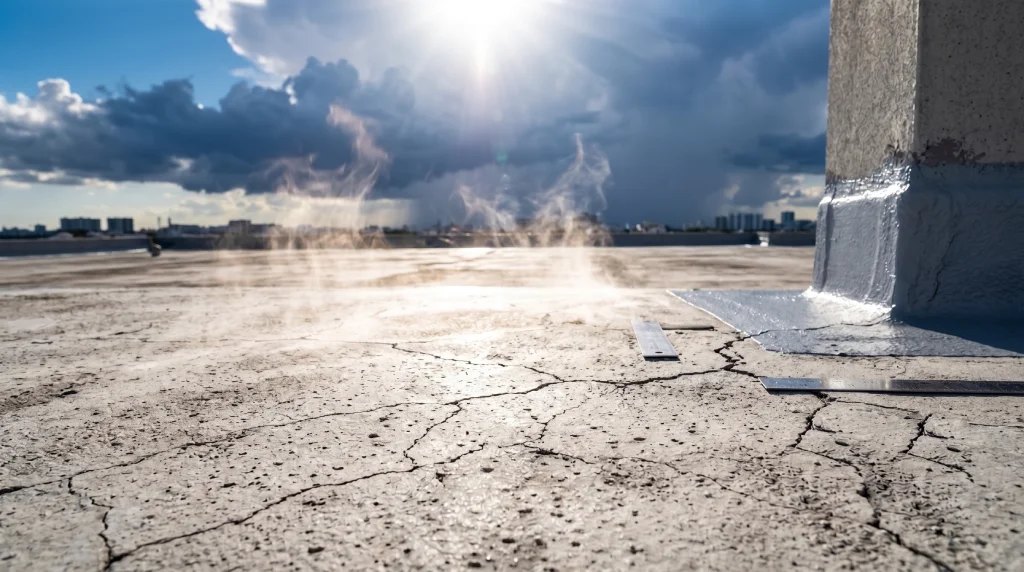
Why True Waterproofing Begins Long Before the First Raindrop Falls
When property owners encounter structural water leaks, ceiling dampness, or peeling interior plaster, their immediate instinct is to blame the wet season. Heavy monsoons, relentless downpours, and pooling rainwater are universally viewed as the primary aggressors. However, structural engineers and materials specialists understand a more deceptive reality.
Water damage rarely begins with water. It begins with the sun.
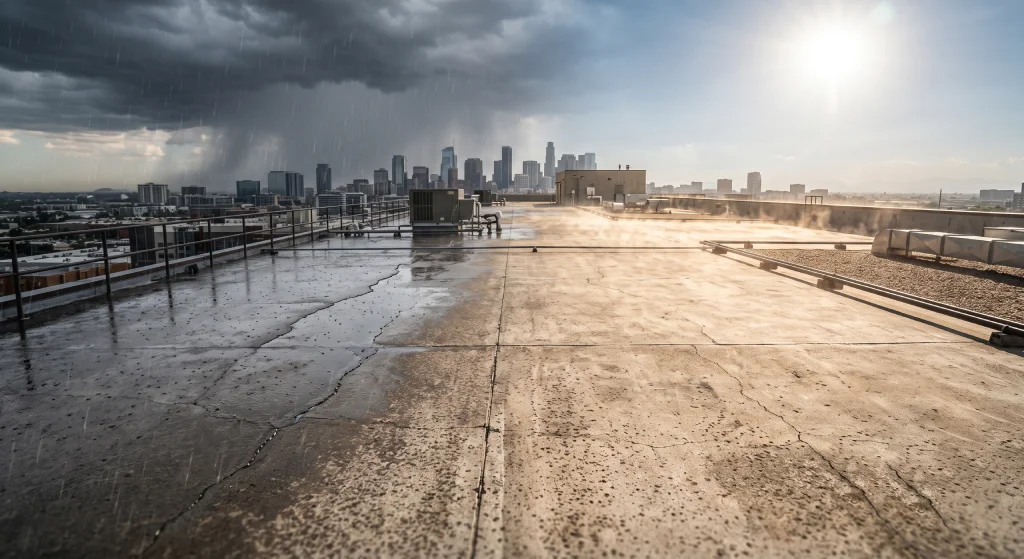
Continuous exposure to intense ambient temperatures and solar radiation subtly, progressively alters the physical characteristics of concrete, steel, and external sealants. By the time the skies open, the environment has spent months preparing your asset for failure. Understanding this relationship is critical to ensuring long-term structural viability.
"Heat starts it. Rainwater spreads it. Extreme heat creates the microscopic pathways; rainwater simply acts as the search mechanism that finds them."
The 4 Invisible Phases of Heat-Induced Structural Damage
To effectively protect an asset, one must analyze exactly how sustained thermal exposure systematically dismantles common building materials. The deterioration occurs via four primary mechanisms:
1. Concrete Spalling (Surface Breakdown)
.webp)
Sustained, intense solar heat elevates the surface temperature of reinforced concrete structures. Because concrete has a relatively low thermal conductivity, a severe temperature differential develops between the blistering outer face and the cooler core underneath. This imbalance causes unequal thermal expansion, forcing the outer micro-layers of concrete to flake, crack, and peel over time. This process exposes the deeper, structural matrix of the slab.
Long-term Impact: Loss of outer surface integrity and the stripping away of natural alkaline protection layers that shield internal structural elements.
2. Structural Steel Expansion (Internal Core Stress)
.webp)
As external thermal loads remain elevated, heat eventually penetrates deep into core building frameworks, impacting embedded reinforced steel bars (rebars) and structural steel joints. Metals expand significantly faster and more aggressively than the surrounding concrete mass. This volumetric change produces massive internal outward pressure, known as thermal stress, within the concrete core.
Long-term Impact: Micro-fractures radiate from internal steel elements outward, altering structural stability and shifting load distribution along beams, pillars, and primary joints.
3. Thermal Movement (Shifting Gaps)
.webp)
Buildings are dynamic systems subjected to continuous diurnal thermal cycles. During the afternoon peaks, building materials expand; during night-time cooling cycles, they contract. When different elements (such as brick masonry abutting concrete beams, or expansion joint sealants adjacent to terrace tiles) expand and contract at differing rates, structural warping and bending take place.
Long-term Impact: Major expansion joints pull away, sealants tear cohesively, and wide, structural gaps appear along critical building interfaces.
4. Material Degradation (The Shield Fails)
.webp)
Standard architectural topcoats, localized waterproofing screeds, and basic acrylic sealants are highly sensitive to high UV radiation and extreme heat. Prolonged thermal exposure causes plasticizers within these chemical matrices to migrate and volatilize. The protective barriers become highly brittle, lose structural elasticity, and begin to powderize or form macroscopic hairline cracks.
Long-term Impact: The external protective shield entirely disintegrates, leaving the underlying raw substrate completely unprotected against subsequent elements.
The Turning Point: When Rain Finds the Fault Lines
Once extreme heat has executed these four phases of degradation, the physical environment of the structure changes. What was once a unified, solid barrier is now an intricate web of micro-fissures, sheared expansion joints, and degraded elastomeric coatings.
When the rain arrives, it does not need to force its way into the building. The pathways have already been paved. Rainwater utilizes natural capillary action to get pulled into the microscopic fractures. Once inside, water travels along the path of least resistance, flowing through heat-stressed concrete, tracking along expanded steel interfaces, and trickling straight down into interior ceilings, plaster systems, and electrical conduits.
A Look Ahead: In our upcoming blog, we will examine the exact physical trajectory rainwater takes once it transitions inside these thermal cracks exploring how internal dampness converts into concrete rot and structural rebar rust.
Proactive Protection: Why Summer is Waterproofing Season
The traditional mistake is reacting to water damage only when active leaks occur during rainstorms. Attempting waterproofing repairs on a water-logged, damp substrate is fundamentally flawed, as trapped moisture will inevitably blister and destroy new coatings from beneath.
True structural protection is preventative and must occur while the asset is dry. By utilizing high-grade, thermal-reflective, and elastomerically stable specialized polymer systems from Tintique Chemicals, you seal existing cracks, eliminate thermal stress by deflecting solar radiation, and establish a permanent barrier before water ever presents a threat.
Protect Your Terrace with Tintique Chemicals
Don't wait for active water seepage to compromise your investment. Contact our technical specialists today to evaluate your roof infrastructure and deploy high-performance protective solutions.
📞 +91-807 179 2487