




.webp)
Introduction
Pouring and finishing concrete is only half the battle. You’ve mixed it right, laid it down perfectly, and smoothed the surface,but the real magic happens after the tools are put away.
There is a common misconception that concrete "dries" to get hard. In reality, it doesn't dry at all; it cures. If you let concrete dry out, you are essentially killing its potential. Whether you're a homeowner fixing up a backyard patio or a civil professional managing a large-scale commercial slab, proper care and curing are non-negotiable steps. They are the ultimate dictators of the concrete's final strength, durability, and lifespan.
What Exactly Happens After Concrete is Placed?
.webp)
When water meets Portland cement, a complex chemical reaction called hydration begins. During hydration, new crystals form,specifically Calcium Silicate Hydrate (C-S-H) gel. As this gel forms, the crystals grow outward and interlock, aggressively binding the sand and gravel together into a solid, impenetrable mass.
Because hydration is an exothermic reaction (meaning it produces its own heat), moisture inside the slab can evaporate quickly if left unchecked. The first 7 to 28 days are the critical window. If moisture escapes too fast, the C-S-H crystals stop growing. Hydration halts prematurely, and the concrete never reaches its full structural capacity.
The 28-Day Rule: Concrete typically reaches about 70% of its strength in the first 7 days of proper curing, but it takes a full 28 days to hit its designed compressive strength.
Why Proper Curing is Crucial for Long-Term Performance
Skipping the curing process isn't just cutting a corner,it structurally compromises the slab.
* Maximizing Compressive Strength: Properly cured concrete can be up to 50% stronger than concrete left exposed to the elements to dry out.
* Preventing Shrinkage Cracking: When surface moisture evaporates rapidly, the top of the slab shrinks faster than the wet core underneath. The tension literally pulls the surface apart, resulting in ugly surface cracks known as plastic shrinkage cracks.
* Stopping Dusting and Scaling: A surface that dries too fast forms a weak, powdery top layer. This leads to "dusting," where the finish constantly sheds dust and wears away under foot traffic.
* Improving Durability: Continuous hydration creates a denser, tighter microscopic structure. This makes the slab more watertight, helping it resist freeze-thaw cycles, de-icing salts, and chemical spills.
Factoring in the Weather: Nature's Impact on Curing
The environment plays a massive role in how fast moisture leaves your slab. You must adjust your curing strategy based on the forecast:
* Hot, Dry, and Windy: This is the most dangerous combination. Wind strips moisture from the surface faster than heat alone. In these conditions, curing must begin immediately after finishing to prevent the surface from crusting over and cracking.
* Cold Weather: Hydration slows down drastically below 50°F (10°C) and stops completely at freezing. If the water inside the concrete freezes before it cures, the expansion will destroy the slab from the inside out. Insulating blankets, rather than just moisture retention, become necessary here.
Traditional Curing Methods vs. Modern Solutions
.webp)
For decades, the standard was wet curing. This involves continuously sprinkling the slab with a hose, building dirt berms to pond water on top, or laying down soaked burlap sacks to keep the surface continuously damp.
While highly effective at preventing evaporation and even providing a cooling effect on hot days, these traditional methods are labor-intensive. They require constant monitoring, if the burlap dries out, it acts as a wick and actually pulls moisture out of the concrete.
Today, the industry relies heavily on a more efficient, set-it-and-forget-it solution: curing compounds.
Spotlight: Concrete Curing Compounds
Concrete curing compounds are liquid membranes formulated from synthetic polymers, resins, or waxes. Instead of adding water to the slab (like wet curing), they lock the internal water in.
They are sprayed or rolled directly onto the freshly finished concrete to form a microscopic, impermeable film. This seals the surface, preventing evaporation and allowing the hydration process to run its full course naturally.
Types of Compounds
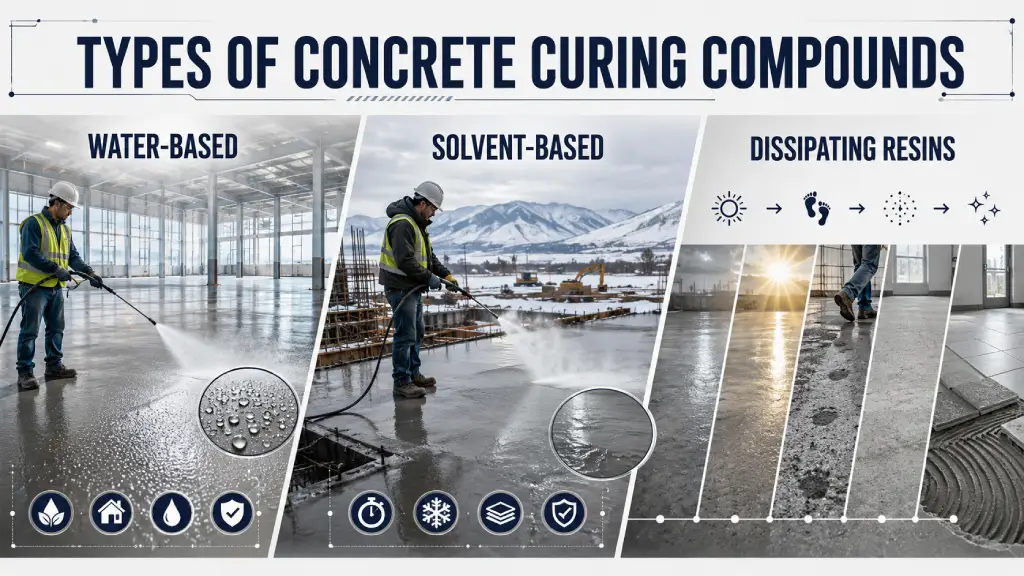
* Water-Based vs. Solvent-Based: Water-based compounds are safer for the environment, have lower VOCs, and are ideal for indoor use. Solvent-based formulas dry faster and often perform better in cold weather.
* Dissipating Resins: These are specifically designed for slabs that will eventually receive floor coverings, tiles, or paint. The membrane breaks down and disappears under UV light and foot traffic over a few weeks, leaving a clean surface for adhesives.
Best Practices for Application
If you decide to use a curing compound, application is straightforward but timing is critical.
Wait for the Bleed Water to Vanish: You must apply the compound immediately after the surface "bleed water" (the watery sheen on top of fresh concrete) has evaporated, but before the actual concrete begins to dry out.
Application Techniques: Use a low-pressure garden-style pump sprayer. Apply it in an even, overlapping pattern. For maximum coverage, apply a second coat perpendicular to the first to avoid any microscopic missed spots.
Conclusion
The structural integrity of a concrete patio, driveway, or commercial floor relies just as much on how it is cared for after the pour as it does on the mix itself. Don't let your hard work evaporate. Treat your freshly placed concrete with proper curing techniques today, and it will reward you with decades of maintenance-free performance.
Ready for your next project? Whether you are a DIY homeowner or a seasoned contractor, Tintique offers the premium concrete care solutions you need to get the job done right. Explore Tintique’s top-tier products today to ensure your concrete not only achieves maximum strength but boasts a flawless, lasting finish.