





Introduction
Epoxy resin has become one of the most widely used materials across industries due to its exceptional strength, durability, and versatility. From industrial flooring and construction to electronics, marine, aerospace, and advanced composites, epoxy resin delivers reliable performance where conventional materials often fall short.
Its excellent bonding capability, resistance to chemicals and moisture, and ability to withstand demanding environments make it the preferred choice for manufacturers, engineers, and designers worldwide.
Whether you're selecting a resin for industrial production or simply looking to understand how epoxy systems work, this guide covers everything you need to know—from the basics of epoxy resin and curing to its different types, properties, advantages, and selection criteria.
What Is Epoxy Resin?
Epoxy resin is a high-performance thermosetting polymer that forms a rigid, durable material after reacting with a curing agent (hardener). Unlike thermoplastics, which soften when heated, thermosetting polymers undergo a permanent chemical transformation during curing, resulting in a material that cannot be melted or reshaped.
This unique characteristic makes epoxy resin ideal for applications requiring long-term mechanical strength, dimensional stability, and resistance to heat, chemicals, and moisture.
Today, epoxy resin is widely used in manufacturing:
Industrial coatings
Structural adhesives
Composite materials
Electrical insulation
Construction chemicals
Marine structures
Automotive components
Aerospace applications
Decorative and artistic projects
Composition of Epoxy Resin
An epoxy system generally consists of two primary components:
1. Epoxy Resin
The resin serves as the base material and contains reactive epoxy groups responsible for forming strong molecular bonds during curing.
2. Hardener (Curing Agent)
The hardener reacts chemically with the resin, initiating the curing process and transforming the liquid mixture into a solid material.
Neither component achieves its full performance independently. Only when mixed in the correct ratio does the system develop its intended mechanical, thermal, and chemical properties.
Resin + Hardener = The Curing Process
Unlike paints that simply dry as solvents evaporate, epoxy resin cures through a chemical reaction.
When the resin and hardener are thoroughly mixed:
Molecules begin linking together.
Heat may be generated naturally (exothermic reaction).
The mixture gradually thickens.
A rigid cross-linked polymer network forms.
The material achieves its final strength after complete curing.
This chemical curing process is responsible for epoxy's superior durability and long service life.
How Does Epoxy Resin Work?
.webp)
Understanding the curing process is essential for achieving consistent performance.
Step 1: Mixing
Epoxy resin and hardener must be measured according to the manufacturer's recommended ratio.
Incorrect proportions can result in:
Soft or sticky surfaces
Reduced strength
Incomplete curing
Premature failure
Accurate measurement is therefore critical.
Step 2: Chemical Reaction
Once mixed, the resin and hardener begin reacting immediately.
During this stage:
Molecular chains start forming.
Viscosity increases gradually.
Heat is generated.
The mixture transitions from liquid to solid.
This process is irreversible.
Step 3: Pot Life
Pot life refers to the amount of time the mixed epoxy remains workable before it begins to harden.
Pot life depends on factors such as:
Resin formulation
Hardener type
Ambient temperature
Batch size
Larger batches generally cure faster because they generate more internal heat.
Step 4: Curing Stages
Most epoxy systems cure in several stages:
Initial Cure
Resin begins to gel.
Material should not be disturbed.
Handling Cure
Surface becomes firm enough for careful handling.
Full Cure
Maximum mechanical strength
Complete chemical resistance
Final heat resistance
Depending on the formulation, complete curing may take several hours to several days.
Factors Affecting Curing
Several external conditions influence epoxy performance:
Temperature
Humidity
Mixing accuracy
Surface cleanliness
Ventilation
Material thickness
Following the manufacturer's processing guidelines ensures consistent results.
Key Properties of Epoxy Resin
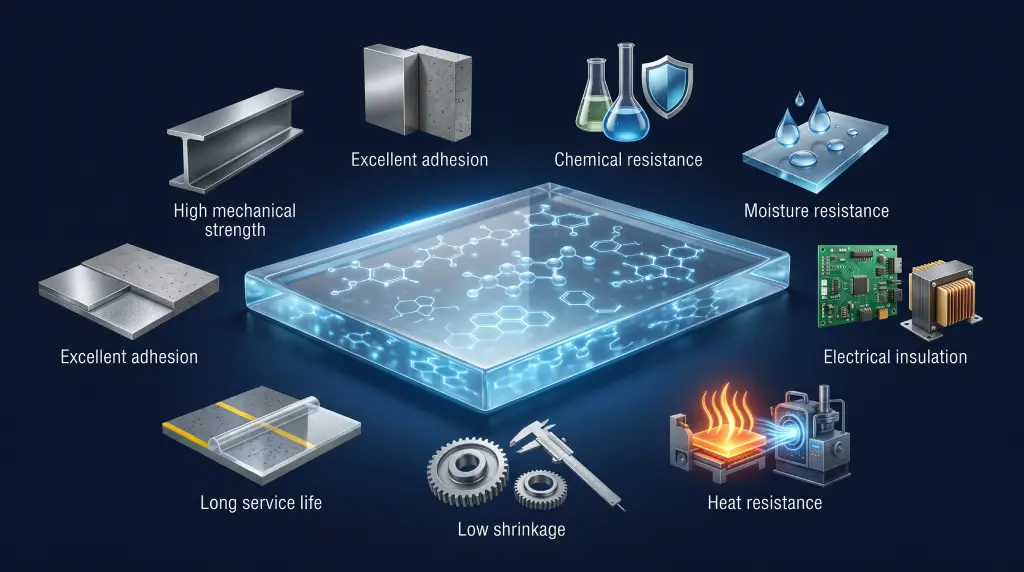
Epoxy resin is valued for its outstanding combination of mechanical, chemical, and thermal properties.
High Mechanical Strength
Epoxy forms a rigid, high-strength polymer structure capable of withstanding heavy loads, impact, and mechanical stress.
Excellent Adhesion
It bonds exceptionally well to:
Metals
Concrete
Wood
Glass
Ceramics
Composite materials
Certain plastics
This makes epoxy one of the industry's most trusted structural adhesives.
Chemical Resistance
Properly cured epoxy resists exposure to:
Oils
Solvents
Acids
Alkalis
Industrial chemicals
This property makes it ideal for manufacturing plants and chemical processing facilities.
Water & Moisture Resistance
Epoxy creates an impermeable barrier that protects surfaces from water penetration, corrosion, and moisture damage.
Electrical Insulation
Its excellent dielectric properties make epoxy suitable for:
Printed circuit boards
Electrical encapsulation
Transformers
High-voltage components
Heat Resistance
Specialized epoxy systems can withstand elevated temperatures while maintaining structural integrity.
Low Shrinkage
Minimal shrinkage during curing helps maintain dimensional accuracy and reduces internal stress.
Long Service Life
When properly formulated and applied, epoxy systems provide years of reliable performance with minimal maintenance.
Types of Epoxy Resins
Different industries require different epoxy formulations. Selecting the appropriate resin depends on the application's performance requirements.
Bisphenol A (BPA) Epoxy Resin
Bisphenol A epoxy is the most widely used general-purpose epoxy resin.
#### Features
Excellent mechanical strength
Strong adhesion
Good chemical resistance
Cost-effective
Advantages
Versatile
Easy processing
Reliable performance
Suitable for a wide range of industries
#### Applications
Industrial coatings
Adhesives
Construction
Composite manufacturing
Flooring systems
Bisphenol F (BPF) Epoxy Resin
Bisphenol F epoxy has a lower viscosity than BPA-based systems.
#### Features
Better penetration
Improved wetting
Enhanced chemical resistance
Easier processing
#### Applications
Protective coatings
Composite laminates
Industrial equipment
High-performance adhesives
Novolac Epoxy Resin
Novolac epoxy is designed for highly demanding industrial environments.
#### Features
Superior chemical resistance
Excellent thermal stability
High cross-link density
#### Applications
Chemical processing plants
Industrial tanks
Heavy-duty protective coatings
Corrosion-resistant equipment
Aliphatic Epoxy Resin
#### Features
Aliphatic epoxy offers excellent resistance to ultraviolet (UV) exposure.
#### Applications
Outdoor coatings
Decorative finishes
Architectural applications
UV-exposed surfaces
Cycloaliphatic Epoxy Resin
Cycloaliphatic epoxy is commonly used in electrical and electronic applications.
#### Features
Excellent dielectric properties
Heat resistance
Low viscosity
Weather resistance
#### Applications
Electrical insulation
Electronic components
High-voltage equipment
Types of Epoxy Hardeners
The hardener significantly influences the final performance of an epoxy system.
Amine Hardeners
Commonly used for:
Industrial coatings
Structural adhesives
Composite manufacturing
Advantages include:
Fast curing
High strength
Excellent chemical resistance
Polyamide Hardeners
Polyamide hardeners provide:
Improved flexibility
Better impact resistance
Excellent adhesion
Enhanced moisture resistance
They are frequently used in marine and protective coating applications.
Anhydride Hardeners
These hardeners are preferred when applications require:
High electrical insulation
Excellent heat resistance
Low shrinkage
Long-term durability
Common in electrical and electronic industries.
Cycloaliphatic Hardeners
Known for:
Weather resistance
UV stability
High-performance coatings
Decorative applications
How Hardeners Influence Performance
Choosing the correct hardener directly affects:
Cure speed
Mechanical strength
Flexibility
Heat resistance
Chemical resistance
Working time (pot life)
Selecting the right resin without the appropriate hardener can compromise the entire system.
Advantages of Epoxy Resin
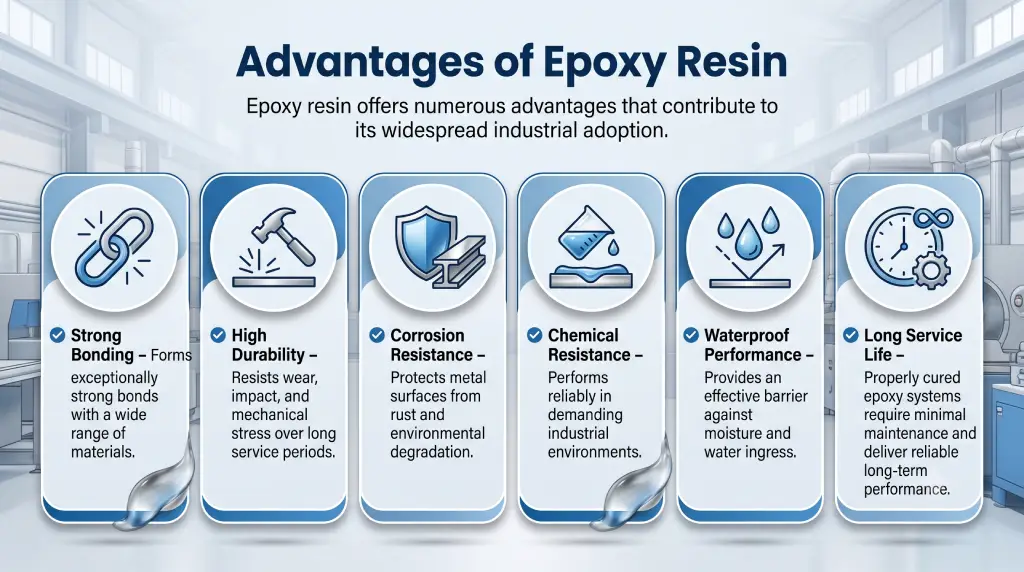
Epoxy resin offers numerous advantages that contribute to its widespread industrial adoption.
Strong Bonding
It forms exceptionally strong bonds with a wide range of materials.
High Durability
Resists wear, impact, and mechanical stress over long service periods.
Corrosion Resistance
Protects metal surfaces from rust and environmental degradation.
Chemical Resistance
Performs reliably in demanding industrial environments.
Waterproof Performance
Provides an effective barrier against moisture and water ingress.
Long Service Life
Properly cured epoxy systems require minimal maintenance and deliver reliable long-term performance.
Limitations of Epoxy Resin
Despite its advantages, epoxy resin has certain limitations.
UV Sensitivity
Standard epoxy systems may discolor or degrade under prolonged sunlight unless UV-resistant formulations are used.
Mixing Accuracy
Precise resin-to-hardener ratios are essential for proper curing and performance.
Limited Pot Life
Once mixed, epoxy must be applied within its specified working time.
Higher Initial Cost
Compared to some alternative resin systems, epoxy generally has a higher upfront cost. However, its durability and longer service life often result in lower lifecycle costs.
How to Choose the Right Epoxy Resin
Selecting the right epoxy system depends on several important factors.
Consider the Application
Different industries require different formulations based on performance requirements.
Evaluate Environmental Conditions
Will the material be exposed to:
Moisture?
Chemicals?
UV radiation?
Outdoor weather?
Choose a formulation designed for those conditions.
Assess Mechanical Requirements
Consider expected:
Load-bearing capacity
Impact resistance
Flexibility
Structural strength
Operating Temperature
High-temperature environments require specialized epoxy systems capable of maintaining performance under thermal stress.
Chemical Exposure
Applications involving solvents, acids, or industrial chemicals should use chemically resistant formulations.
Budget vs. Performance
While cost is an important consideration, selecting a higher-quality epoxy often reduces maintenance, repairs, and replacement costs over time.
Conclusion
Epoxy resin has earned its reputation as one of the world's most versatile engineering materials. Its exceptional strength, superior adhesion, chemical resistance, and long-lasting durability make it indispensable across construction, manufacturing, marine, automotive, electronics, and many other industries.
Understanding the different types of epoxy resins, their curing mechanisms, and the role of hardeners helps ensure you select the right system for your specific application and achieve the best possible performance.
In the next part of this series, we'll explore where epoxy resin is used across industries, examining real-world applications, best practices, and common mistakes to avoid when working with epoxy systems.