





.webp)
Introduction
Imagine spending years planning, designing, and saving for your dream home. You pick out the finest premium bricks, invest in high-end flooring, and select the perfect interior paint palette. Now, imagine walking into that brand-new living room just two years later, only to see ugly, damp yellow patches creeping across the ceiling and peeling away your expensive paint. It’s a heartbreaking sight, but unfortunately, it’s a reality for thousands of new homeowners.
The reality check most people face is that they only think about waterproofing after they see a visible leak. By the time dampness breaks through your walls, the internal damage to the structure is already done. Water has already traveled through the slab, compromised the plaster, and potentially started corroding the internal steel.
At Tintique Chemicals, we believe in a golden rule that saves homeowners thousands of dollars and endless headaches: Waterproofing starts before the damage. True protection begins while the house is still a blueprint, long before the concrete even dries.
The Ultimate Threats: Heat and Rain
Your house is constantly under siege by two relentless environmental villains: intense seasonal heat and heavy monsoon rains. During the scorching summer months, your building materials endure immense thermal stress. Concrete, bricks, and mortar expand under the baking sun. When temperatures drop at night or during a sudden downpour, the materials contract. This continuous movement creates microscopic gaps and fine hairline fractures along structural joints.
When the monsoon arrives, rainwater capitalizes on these tiny vulnerabilities. Water doesn't just sit on your roof; it finds every microscopic pathway, tracking along these gaps and soaking deep into the bones of your home.
This is exactly why pre-construction waterproofing matters so much. Addressing these vulnerabilities during the initial build is highly effective, relatively inexpensive, and becomes a permanent part of the structure. Trying to fix a major leak after the home is complete means breaking expensive tiles, drilling holes into your slabs, injecting chemicals blindly, and dealing with massive, stressful repair bills.
The 4 Pillars of Pre-Construction Waterproofing
To build a truly leak-proof home, you must integrate protection into every stage of the core structure. Here are the four fundamental pillars of smart, pre-construction waterproofing.
Ribbon Treatment (Sealing the Weakest Links)
 (1).webp)
What it is: This technique involves placing specialized, high-performance waterproofing ribbons (such as swelling waterstops or joint sealing tapes) precisely along construction joints.
Why it matters: Construction joints are the natural seams formed when a fresh batch of concrete is poured against concrete that has already hardened. Because they are separate pours, these joints are the absolute weakest links in a structure. Waterproofing ribbons act as a dynamic physical barrier; when they come into contact with moisture, they expand to tightly seal the joint, blocking water entry points completely.
Steel Protection (Stopping the "Concrete Cancer")
.webp)
What it is: This involves utilizing pre-coated, corrosion-resistant steel rebar or applying a dedicated protective resin coating directly onto the steel reinforcement bars before they are laid down in the formwork.
Why it matters: Concrete is naturally porous. When moisture inevitably finds its way inside, it hits the internal steel rebar. As steel rusts, it expands up to several times its original volume. This internal pressure causes the surrounding concrete to crack, split, and fall away, a devastating structural deterioration known in the industry as "concrete cancer." Protecting your steel bars ensures the structural backbone of your home remains completely intact for decades.
Waterproofing Before Tiling (The Hidden Shield)
What it is: This process requires applying a continuous, flexible waterproof membrane directly onto the raw concrete slabs and wall joints before any terrace or bathroom tiles are installed.
Why it matters: Many homeowners assume that tiles and grout are waterproof. They aren't. Over time, tile grout degrades, cracks, or washes away due to foot traffic, cleaning chemicals, and weather exposure. Without a secondary, liquid-applied shield hiding beneath the tiles, any water that slips through the grout lines will instantly soak into the floor slab and ruin the rooms directly below.
Strengthening the Slab (Integral Waterproofing)
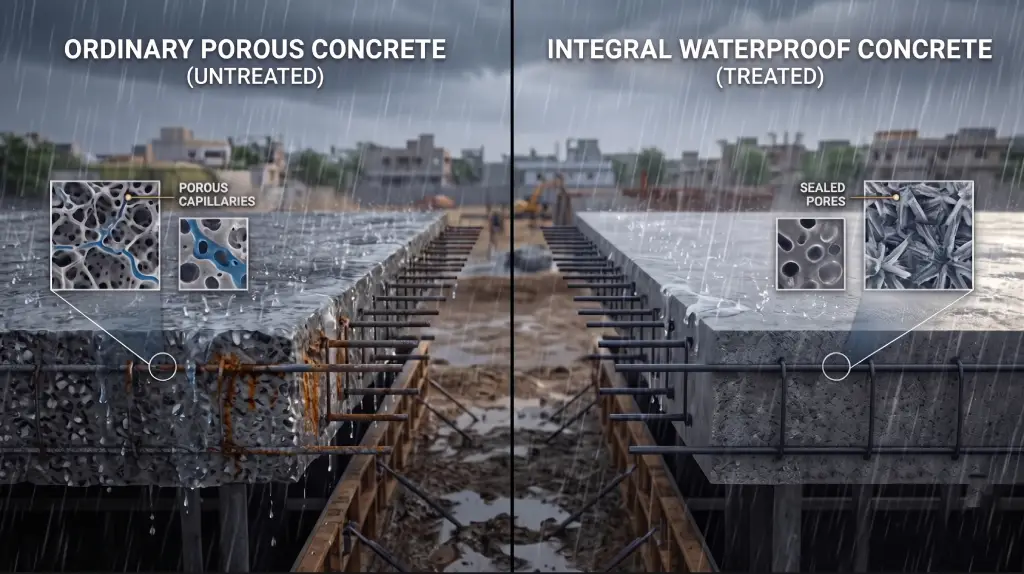
What it is: This method introduces advanced liquid chemical additives directly into the concrete mixer while the batch is being prepared for the foundation, pillars, and roof slabs.
Why it matters: Rather than just protecting the surface, integral waterproofing changes the chemical nature of the concrete itself. It modifies the internal matrix, filling and closing the microscopic capillaries and pores that naturally form as concrete cures. This transforms the entire concrete slab into a highly hydrophobic, water-repelling shield from the inside out.
The ROI of Proactive Waterproofing
When you are managing a massive construction budget, it can be tempting to cut corners on things you can't see, like waterproofing. However, looking at the financial return on investment (ROI) completely changes the perspective.
The Math of Masonry
Pre-Construction Cost: Integrating waterproofing products into your concrete, joints, and sub-surfaces during the initial build is highly predictable and typically accounts for just a tiny fraction (often less than 1% to 2%) of your overall construction budget.
Post-Damage Repair Cost: Fixing a leak after the house is built is an absolute financial nightmare. It easily costs up to 5x more because you aren't just paying for the waterproofing chemical, you are paying for the demolition of expensive tiles, hauling away debris, structural concrete repairs, re-tiling, and completely repainting ruined interiors.
Conclusion
At the end of the day, a truly strong, luxurious home isn't just defined by premium materials, elegant architecture, and beautiful tiles. It is defined by a dry, healthy, and secure foundation that protects everything inside it. Don't wait until the plaster starts peeling to think about moisture control, build it right the first time.
Ready to ensure your new home stands the test of time against the harshest weather? Keep an eye out for our next post: Implement protection that lasts!
Partner with the Experts
Don't leave your dream home's structural integrity to chance. Contact the Tintique Chemicals team today to consult with your builder, contractor, or architect about building a leak-free home from day one.
Contact Tintique Chemicals: 📞 +91-807 179 2487
