





.webp)
Introduction
Your terrace is the unsung hero of your home. Day in and day out, it relentlessly bears the brunt of every extreme season, from scorching, blistering summer afternoons to torrential monsoon downpours. Because it looks solid, we tend to treat it as indestructible. But here is the hard truth: concrete is surprisingly sensitive to the elements. What looks like a harmless, minor hairline crack today can easily transform into a structural nightmare tomorrow.
Water seepage isn't just an ugly cosmetic eyesore that ruins your interior paint and leaves musty odors; it is a fast-moving, silent enemy that actively compromises your home’s safety.
To save your home (and your wallet), you need to understand how this enemy operates.
Let’s break down the hidden 4-step lifecycle of terrace decay, look at the warning signs, and discover exactly how you can protect your investment before repairs become astronomically expensive.
The Terrace Decay Lifecycle at a Glance
Before diving into the details, here is a quick overview of how a small thermal shift escalates into a structural crisis:
Stage 1: The Setup - Crack Formation
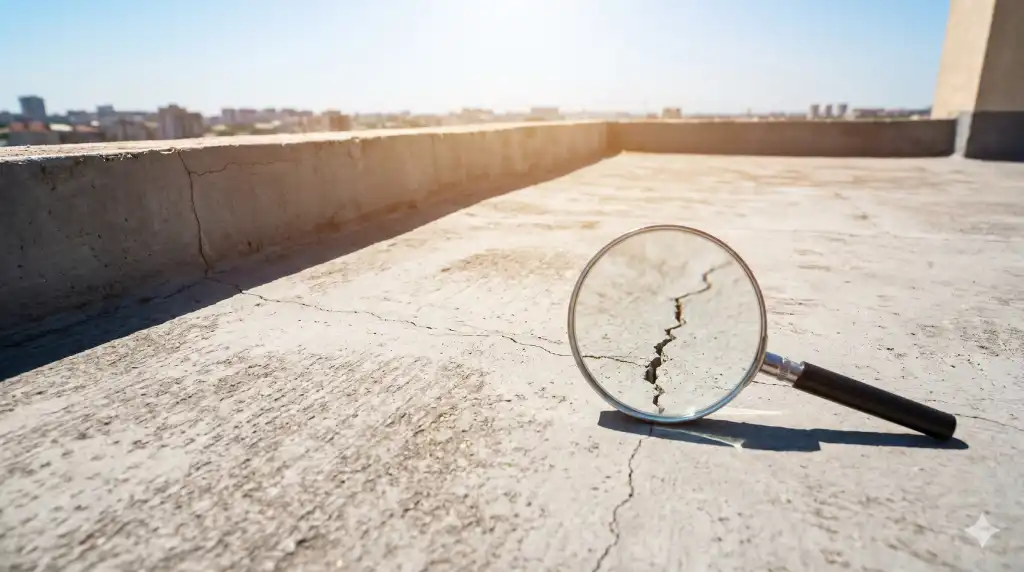
The Culprit: Intense summer heat and thermal expansion.
It all starts long before the first raindrop falls. During peak summer, daytime temperatures bake your terrace slab, causing the concrete to expand. At night, as the temperature drops, the concrete contracts.
This constant, daily tug-of-war causes immense internal stress. Because concrete is rigid and lacks elasticity, it eventually gives in to the strain. Microscopic surface cracks begin to form across the floor and along the parapet joints.
The Hidden Danger: You might not even notice these fractures at first glance. They are often smaller than a strand of hair, but to water, they are wide-open, standing invitations.
Stage 2: The Infiltration – Water Seepage
.webp)
The Culprit: Rainwater and poor drainage.
When the monsoons finally arrive, your terrace becomes a battlefield. Rainwater doesn't just sit idly or roll off into the drains; it actively seeks out the path of least resistance.
Those tiny thermal cracks formed during the summer act like microscopic straws. Through a process known as capillary action, they suck moisture deep down into the concrete slab. Once water penetrates the outer surface layer, it begins migrating horizontally and vertically through the internal pores of the structure.
The Warning Signs: You'll begin to notice damp patches on the ceiling directly below the terrace, peeling or bubbling paint, and the appearance of white, powdery deposits (efflorescence) on your indoor walls.
Key Takeaway: Once water gets under the surface, a destructive countdown clock starts ticking. It is no longer a matter of if damage will spread, but when.
Stage 3: The Internal Chaos – Steel Corrosion
.webp)
The Culprit: Trapped moisture meeting reinforced steel (rebar).
Modern terraces aren’t just made of concrete; they rely on an internal skeleton of reinforced steel rebar to stay structurally stable. Concrete provides compressive strength, while steel provides tensile strength. But when the invading rainwater reaches this internal steel skeleton, disaster strikes.
Oxygen, water, and steel trigger a chemical reaction: rust. As steel corrodes, it undergoes a terrifying physical transformation, it expands up to several times its original volume.
This massive internal expansion exerts immense pressure on the surrounding concrete from the inside out. The concrete simply cannot handle this internal outward pressure, causing it to split, fracture, and separate from the metal.
The Warning Signs: Reddish-brown rust stains bleeding through your ceiling plaster and widening cracks along the underside of the slab.
Key Takeaway: Weakened steel means a compromised foundation. Your home's primary support system is now actively fighting against itself.
Stage 4: The Final Blow - Total Structural Damage
.webp)
The Culprit: Neglect and time.
This is the endgame of terrace decay. Left unchecked, the internal pressure from the rusting steel causes spalling, a severe condition where large chunks of concrete completely crack, break away, and fall off, exposing completely rusted, crumbling structural beams.
At this stage, you are no longer dealing with a minor leak, a damp spot, or an ugly ceiling patch. You are facing a home that is becoming fundamentally unsafe to live in.
The Reality: Structural integrity is compromised, indoor flooding becomes normal during heavy rains, and the risk of localized ceiling collapse increases drastically.
The Financial Reality: Proactive vs. Reactive
.webp)
The trajectory of repair costs is steep. Catching the problem early changes everything:
Preventive Maintenance (Stages 1–2): Highly affordable, quick, non-invasive, and completely stress-free. It takes just a few hours to seal a terrace properly.
Structural Reconstruction (Stages 3–4): Incredibly disruptive, highly stressful, and devastatingly expensive. It requires breaking the concrete, replacing or reinforcing structural steel, and re-casting the slab.
The Solution: Defend Your Home with Tintique Chemicals
Most homeowners wait until they see water actively dripping onto their living room sofa or electronics before they call a professional. By then, the damage has already escalated to Stage 3 or 4. Being reactive costs a fortune; being proactive saves your home.
The smartest way to break this cycle of decay is to seal those cracks at Stage 1 or 2 using advanced chemical technology rather than temporary fixes.
Why Traditional Patches Fail
Standard cement washes or basic acrylic coats simply sit on top of the terrace like a thin sheet of plastic. When the next summer heatwave hits, they lose their bond, crack open, and let water right back in.
The Fix: Advanced UPR Technology
Tintique Chemicals offers specialized UPR (Unsaturated Polyester Resin) crack-sealing solutions.
Unlike basic patches, UPR is formulated to penetrate deep into the finest micro-fractures via the same capillary pathways that water uses. Once inside, it cures into a flexible, rock-solid, and completely non-porous polymer matrix.
High Elasticity: It expands and contracts seamlessly with the concrete during temperature shifts, meaning it won’t crack next summer.
Absolute Barrier: It locks out moisture completely, ensuring water never gets the chance to reach your internal steel reinforcement.
Protect Your Terrace Today
Don't wait for the next heavy downpour to tell you that your roof is failing. Take control of your home's structural health before minor cracks turn into major construction bills.
Contact Tintique Chemicals today at +91-807 179 2487 for an expert consultation, site inspection, and structural evaluation.
Conclusion: Your Home Deserves a Lifetime Guarantee
When we buy or build a home, we think in terms of generations. We invest in interior decor, premium furniture, and long-term security. Yet, the longevity of that entire investment depends entirely on the few inches of concrete facing the sky.
Terrace decay is entirely predictable, but it only wins if it is ignored. Waiting for water to drip into your living room before taking action is like waiting for an engine to seize before checking the oil. By choosing to intercept the damage at Stage 1 or 2 with advanced UPR technology, you effectively hit the reset button on your roof's aging process.
Do not let a completely preventable natural cycle dictate the lifespan of your property. Put up a permanent shield against the elements, keep the structure rock-solid, and ensure that the next heavy storm brings nothing but the soothing sound of rain outside, not a crisis inside.
